athni.pl
Uses a parameter of the form:
rand_666 tritone_1 noise_self/default/default7/triadic/345 bridge_30 hocket_10,15,25 size_70 ser_8b09a3241567All items are optional.
- rand: is the seed for the random number generator
- tritone: if specified, forbids series with tritones between two consecutive notes
- noise: classifies chords as consonant, or dissonant (noise)
- default
This is an approximation to basic triadic harmony. Thirds and sixths get very high grades, fifth and octaves somewhat lower grades, major seconds are bad, minor seconds worst... Chords are graded by averaging all the intervals they contain.- triadic
Only triads and their subsets are consonant.- default7
Like triadic, but V7 and some of its subsets are consonant.- self
This means that only groups of 1,2,3 and 4 notes from the series, transposed or inverted will be considered consonant.For instance, if the series is:
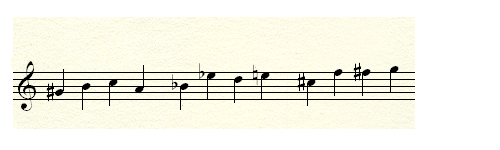
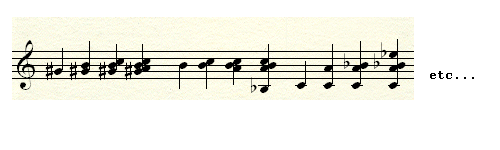
it should be harmonized only by the chords:
with their transpositions and inversions.- 345
A code like this means that the intervals of 3,4 and 5 semitones and their inversions are consonant. Unisons/octaves are always consonant (according to Schoenberg they should be dissonant) .
All the other intervals are dissonant.
- bridge: probability, in percents of extending notes across rests (suspensions, may create dissonance)
- hocket: three numbers, separated by commas (no blanks). These are used as limits for generating hockets, i.e. splitting, in certain cases, notes longer than the limits into shorter notes and rests. Default: 10,15,20
- size: how many phrases to generate (default: 100)
- ser: the code 8b09a3241567 specifies the series:
8 11 0 9 10 3 2 4 1 5 6 7 ( in the parameter ser, a=10 and b=11 ) i.e. A♭ B C A B♭ E♭ D E C# F F# G If ser is missing, the series is generated at random.
Defines the series
writes PARM.txt which contains the input parameters and the series, e.g.:
{
SRAND 666
SER 8 3 1 6 7 4 10 2 9 5 11 0 0 11 5 9 2 10 4 7 6 1 3 8 4 9 11 6 5 8 2 10 3 7 1 0 0 1 7 3 10 2 8 5 6 11 9 4
NOISE SELF
BRIDGE 30
HOCKET 10,15,25
SIZE 70
}
newathnj.pl
Athematic perpetual development, IGNORING DURATIONS
Creates SIZE phrases, then adds the same phrases in reverse order, some cancrizans.
The probability of having a cancrizans phrase increases with phrase number, and is one near the end.E.g., if SIZE = 50, the program will generate 50 phrases (numbered 0 to 49); then
In total, 100 phrases numbered 0 to 99 (twice SIZE)phrase 50 is the same as phrase 49 (or phrase 49 played backwards) phrase 51 is the same as phrase 48 (or phrase 48 played backwards) . . phrase 98 is the same as phrase 1 played backwards phrase 99 is the same as phrase 0 played backwards
Contains routines: MAIN paralel adentry enlistphr stdphr
Writes and reads noizez.txt : grades for all combinations of <= 12 distinct tones
There is no HARMONY OPTIMIZATION, a chord is either consonant or dissonant
The results are written to STANDARD OUTPUT
Modifies the phrases generated by newathnj by bridging notes over rests
Definitely spoils harmony (creates suspensions)
The results are written on three files:
The format is identical to the output of newathnj.pl, omitting the
phrases creation log.
The program produces the same result as athno.pl
from the "Athematic Konzertstuck".
This will serve as first movement in the concerto.
Reads PARM.txt
Reads noizez.txt : grades for all combinations of <= 12 distinct tones
Reads and uses the phrases in head.txt
Writes the score file scora.txt.
Program structure:
The program uses cadences to subdivide the movement. Longer subdivisions (at least two of them) will become concertinos, i.e.
one of the following instruments
"Romanze" means I tried to get a smooth, dreamy melody by using patterns. Did not particularly succeed, although the movement has a character of its own.
Implemented via two programs actino.pl, bctino.pl .
Reads files PARM.txt tail.txt
Writes file pass.txt
Program structure:
Reads files PARM.txt, pass.txt
Writes score file scorb.txt
Program structure:
Reads files PARM.txt, mid.txt
Writes score file scorc.txt
Program structure:
The routines embelish, nearenough, patmach, rewrite in bctino.pl analyse each phrase,
to find groups of notes near enough to (a transposition of) the notes in a pattern,
and apply the pattern rhythm to them. That may scramble the notes somewhat; there may also be notes
left over, which
will serve as ostinato bass for the melody in the pattern.
So the five patterns are heard many times, usually slightly modified,
during the whole second movement.
The coda, however, does not use embelish, so its rhythms are much simpler an non-distinctive. Eventually it ends with no rhythm at all:
the series played in equal durations, molto rallentando.
An example of notes rearrangement, when a pattern is created in actino.pl:
Notice that the notes in pattern more or less fit the order in the rows 6..8, but not exactly.
The note 7 (g or sol) in row 6 has disappeared from the pattern. It is still saved, in row 6, in the table BYTON.
Also notice the "romanze rhythm"
brig.pl
Reads PARM.txt and the output of newathnj.pl
head.txt:
phrases n0 to SIZE*0.6 (n0 at random, between 7 and 15.
head.txt does not start with first phrase.)
tail.txt:
phrases SIZE*1.2 to SIZE*2.
mid.txt:
phrases SIZE*0.6 to SIZE*1.2
First movement: program hea.pl
The routine readphr reads the input, then analyzes the phrases for cadences.
The routine codaindex sets the position near the end of the score after which
cadential phrases are allowed.
makescore calls:
one midi channel = one voice = one sound.
Chords are, of course, natural for piano. Same results as genscor.
Second movement: Tema con Concertini, Romanze
will play solo, virtuoso music. The rest will have the piano as soloist, as the rest of the concerto; the piano is also active
as an accompanist or participant in the concertino.
actino.pl
This is, basically, a preprocessor for bctino.pl. Based on cadences, it defines concertinos and selects phrases to be played.
It may fail, if there are not enough cadences or concertinos.
mvfr (i.e. most voices to fast rhythms )
looks for 3..5 distinct notes sounding simultaneously
– in the same row – in the phrase. That row and its neighbors are converted to patterns by
makepat, makepat2, then the pattern situation is encoded in the phrase by clober
– a few rows won't contain notes, but just references to the pattern.
bctino.pl
For each one of the selected phrases:
The rhythm is some relatively simple subdivision of the 3/4 measure.
It will be used outside of patterns and cadences,
and is the same for the whole phrase.
For each segment, emit using one of:
Third movement – program toca.pl
Each phrase gets analyzed for cadences, and two versions are saved: @ASIS (phrase as is) and @BYTON (phrase
scrambled so identical tones appear in the same voice )
Phrases which are allowed by the routine accephr are emitted using one of:
toxcor:
toccata score; piano toccata, accompanied
orxtyp:
pure orchestral, no piano, smooth rhythm, voices in counterpoint
tortyp:
orchestral toccata – the various instruments play toccata rhythms. Uses percussion, which I cannot
otherwise fit in my dodecaphony: there are no tones for drums and such.
cad:
cadential phrases
coda:
the final, "most definitive" cadence
Patterns
The patterns are melodies, i.e. tones with rhythms, where the rhythms are chosen from a set I think fits a Romanze.
All are based on a 3/4 time signature, and take a few complete measures. There are just five of those, defined in actino.pl
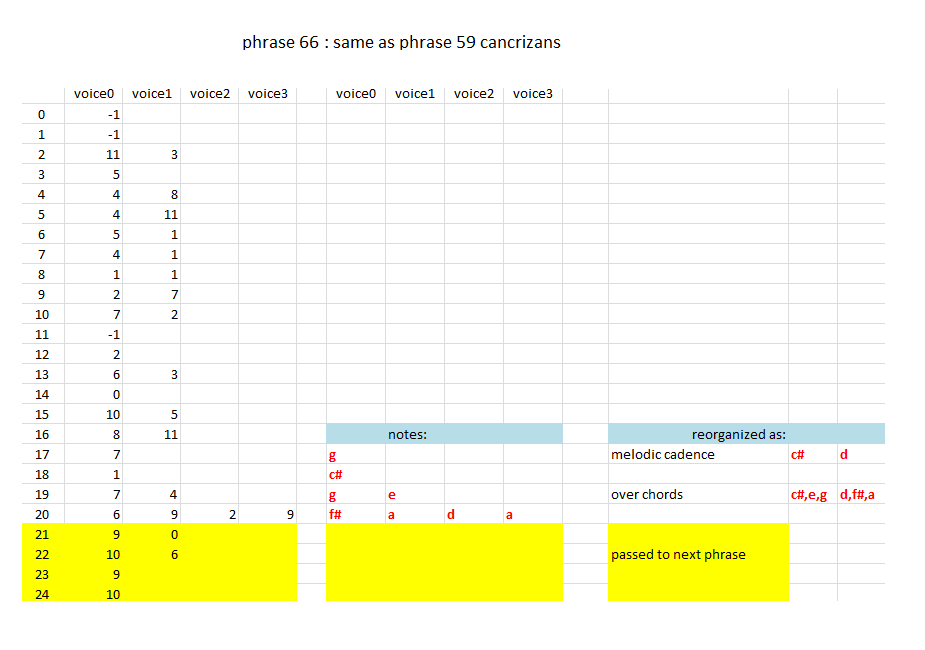
by the routines mvfr, makepat, makepat2.Rearrangement
phrase 54 before storing
pattern 54,6,8 in PATS: phrase 54: tones without duration,
tones with durations in pattern phrase 54 after clober:
K54,6,8 identifies the pattern, all the plain 'K' ignored
  0          4        ..        ..
  1          5         8        ..
  2          8        11        ..
  3          2        ..        ..
  4          4         9        ..
  5          3         6        ..
  6          6         7        ..
  7          1         5        10
  8          1         6         9
  9          1        ..        ..
 10          1         2         7
 11          1         4        ..
 12          5        ..        ..
 13          3         8        11
 14          2        ..        ..
 15          7        ..        ..
 16          1        ..        ..
 17          1        10        ..
 18          1        10        ..
 19          9        ..        ..
 20          9        ..        ..
 21          3         6        11
  0          4        ..        ..
  1          5         8        ..
  2          8        11        ..
  3          2        ..        ..
  4          4         9        ..
  5          3         6        ..

54,6,8,     6 5/16  1 1/16  5 1/16  10 1/16
            6 1/4   9  1/4  1  1/4  1  1/4
  9          1        ..        ..
 10          1         2         7
 11          1         4        ..
 12          5        ..        ..
 13          3         8        11
 14          2        ..        ..
 15          7        ..        ..
 16          1        ..        ..
 17          1        10        ..
 18          1        10        ..
 19          9        ..        ..
 20          9        ..        ..
 21          3         6        11
		phrase 54
  0          4        ..        ..
  1          5         8        ..
  2          8        11        ..
  3          2        ..        ..
  4          4         9        ..
  5          3         6        ..
  6    K54,6,8         K         K
  7          K         K         K
  8          K         K         K
  9          1        ..        ..
 10          1         2         7
 11          1         4        ..
 12          5        ..        ..
 13          3         8        11
 14          2        ..        ..
 15          7        ..        ..
 16          1        ..        ..
 17          1        10        ..
 18          1        10        ..
 19          9        ..        ..
 20          9        ..        ..
 21          3         6        11
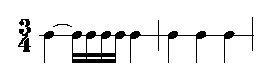
Pattern: melody and bass in bctino.pl
For instance, the routines embelish and patmatch might find the following three chords in a phrase:
	.
	.
15		0		3		8
16		0		9		..
17		0		9		4
	.
	.
and match the notes to the pattern K54,6,8:
6 5/16 1 1/16 5 1/16 10 1/16 6 1/4 9 1/4 1 1/4 1 1/4
after transposing up by 3 (or 2) semitones. The resulting melody is:
9 5/16 4 1/16 8 1/16 0 1/16 9 1/4 0 1/4 4 1/4 4 1/4
and the note 3 ( e flat, mi bemol ) is missing in it. It will be used as bass (rather dissonant) for the melody above.
The order of the notes in the melody is quite different from their order in the chords.